

Nonograms Online
A nonogram is a picture logic puzzle: numbers around a grid tell you which cells to paint, and when every row and column agrees, a hidden picture or pattern appears. You may also know it as a picture-logic or pixel puzzle. Here you get a new Daily Nonogram every day at midnight in your own time zone, plus a Practice tab with four sizes, from a 5×5 mini to a 20×20 challenge. Every puzzle on this site has exactly one solution, and every one can be finished by reasoning alone — you never have to guess.
Nonogram rules
Each row has a list of numbers on its left, and each column has a list above it. Those numbers are the clues.
- Each number is a block — a run of painted cells side by side in that line, in the order given. The clue 3 1 means a run of three painted cells, then, further on, a run of one.
- Blocks are separated by at least one blank cell. How many blanks, and where, is for you to work out.
- Every row and every column must match its clue at the same time. When they all do, the puzzle is solved and the picture is complete.
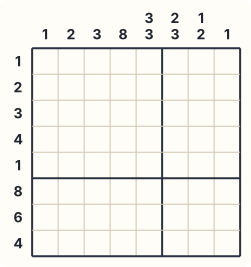
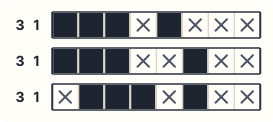
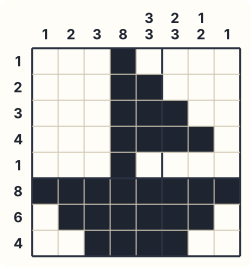
A clue of 0 means the whole line is blank. Crossing out cells you know are blank (with ✕) is not required, but it makes the next deductions much easier to see.
How to solve a nonogram
Nonograms are solved one line at a time. Look at a single row or column, its clue and the cells you already know, and ask: which cells are painted, or blank, in every possible way the clue can fit? Those cells are certain. Each new certain cell gives the crossing line new information, and the picture grows from there. The techniques below go from the quickest to the most thorough.
1. Overlap: big blocks always cover the middle
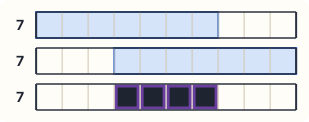
Slide a block as far left as it can go, then as far right. Cells covered in both positions are painted whatever happens. In a line of 10, a block of 7 always covers cells 4 to 7. The same works for several blocks: place them all to the left, then all to the right, and compare each block with itself.
2. Edges: a painted cell at the border anchors a block
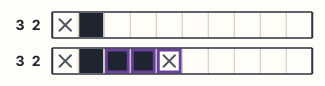
If the first cell that is not crossed out is painted, the first block must start exactly there — nothing can come before it. Paint the full length of that block and put a ✕ right after it. The same rule works from the other end of the line with the last block.
3. Unreachable cells: cross them out
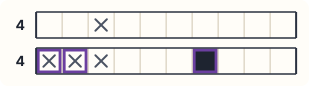
Crosses split a line into gaps. A gap shorter than every block that could go there stays blank. Cells beyond the farthest reach of the first or last block are blank too. Once all the blocks of a line are painted, everything else in that line is blank.
4. Check every arrangement of one line
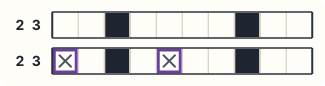
When the quick rules stop working, think through all the ways the whole clue can fit the line as it is now. A cell painted in every arrangement is painted; a cell blank in every arrangement is blank. In the example, the block of 2 must cover cell 3 and the block of 3 must cover cell 8, so cells 1 and 5 can never be painted. Medium and hard puzzles need this step regularly.
5. One-step assumption
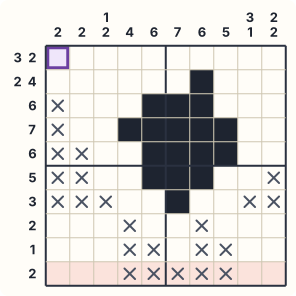
On the hardest puzzles, every line can be stuck at once. Then pick one cell and suppose it is painted (or blank). Follow the line rules from there. If some row or column ends up impossible, your supposition was wrong, and the cell must be the opposite. This is not guessing: you only keep a result that is proven. The Hard level and the Friday and Saturday dailies need this, but only one step deep.
Habits that save time
- Start with the biggest numbers: the larger the block compared with the line, the more it overlaps.
- Add up a clue: blocks plus one gap between each. If the total equals the line length, the whole line is decided.
- After every new cell, look at the crossing line — that is where the next deduction usually is.
- Tap a clue number to gray it out as a memo when you have placed that block.
Sizes and difficulty
| Level | Grid | Logic needed | Typical time |
|---|---|---|---|
| Mini | 5×5 | Overlap, edges and reach only | About 1 minute |
| Easy | 10×10 | Simple rules, sometimes a full line check | 3–8 minutes |
| Medium | 15×15 | Full line checks, sometimes one assumption | 10–25 minutes |
| Hard | 20×20 | At least one one-step assumption | 25–60 minutes |
The grade is not guessed by hand: our solver works through each puzzle with the techniques above, simplest first, and records the hardest one it needed.
The Daily Nonogram week
| Day | Grid | What to expect |
|---|---|---|
| Monday | 10×10 | Simple rules only — a gentle start |
| Tuesday | 10×10 | Needs a full line check |
| Wednesday | 15×15 | Full line checks |
| Thursday | 15×15 | Full line checks |
| Friday | 15×15 | Needs a one-step assumption |
| Saturday | 20×20 | The big one, with assumptions |
| Sunday | 15×15 | A hand-drawn picture to reveal |
The weekday follows your device's local date. Sunday pictures are original drawings made for this site — everyday objects such as a mug, a sailboat or a bird — and the name of the picture appears when you finish. The text you share carries only your time and hints, never the picture.
Controls
- Tap or click a cell to cycle painted → ✕ → blank. The tool switch below the grid can make every tap paint, or every tap mark ✕.
- Drag across a row or column to apply the same action to the whole stroke. A stroke only changes cells that started like the first one, so painting never wipes out your crosses.
- Long-press (or right-click) to mark ✕ directly.
- Zoom gives big cells on a phone; the clue numbers stay pinned while you scroll. Use two fingers to move around the grid.
- Keyboard: arrow keys move, Space paints, X marks, Backspace clears, Shift with an arrow keeps applying the last action, Ctrl+Z undoes and Ctrl+Shift+Z redoes.
Frequently asked questions
- Are these nonograms free to play?
- Yes. Every daily and practice puzzle is free, with no account or sign-up. Your progress and statistics are saved in your own browser and, if you want, kept in step across your devices.
- What time does the Daily Nonogram change?
- At midnight in your device's time zone, so everyone gets a fresh puzzle at the start of their own day. If you were in the middle of yesterday's puzzle, you can still finish it.
- Do I ever need to guess?
- No. Before a puzzle is published, a computer solver proves that it has exactly one solution and that line-by-line reasoning — at most a one-step assumption — reaches it. If you are stuck, a hint shows the next cell that can be proven and explains why.
- Which size should I start with?
- Start with Mini (5×5) to learn how clues work, then Easy (10×10). Medium and Hard add more lines to juggle and need the full line check and the one-step assumption described above.
- How do hints and mistake checking work?
- You get three hints per puzzle. A hint first points out a wrongly painted or wrongly crossed cell, if there is one, and otherwise highlights the next cell you can prove. Mistake checking is off by default; if you turn it on, wrong cells are outlined and your daily result is marked as checked.
- Can I play nonograms on my phone?
- Yes. The grid fits the screen for small puzzles, and the zoom button gives large cells for 15×15 and 20×20 grids with the clues pinned to the edges. Drag to paint whole runs, long-press to mark ✕, and use the tap tool switch to avoid mistakes.