


Killer Sudoku Online
How Killer Sudoku works
Killer Sudoku keeps every rule of classic sudoku and takes away the starting digits. In their place the grid is cut into cages, outlined with dashed lines. The small number in the top-left corner of a cage is the sum of the digits inside it. Your job is to fill the grid so that all of those sums come out right.
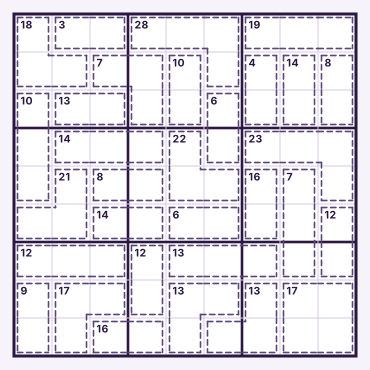
- Every row, every column and every 3×3 box holds the digits 1 to 9 exactly once.
- The digits in a cage add up to the number printed in its corner.
- A digit cannot repeat inside one cage. The same digit may appear in two different cages, as long as the sudoku rules allow it.
- There are no given digits, and every puzzle has exactly one solution. You never have to guess.
Select a cell and type a digit, or tap the number pad on a phone. Switch on notes to pencil in candidates. With the combination helper turned on, a line under the board lists every set of digits that can still fill the cage of the selected cell, and crosses out the sets that clash with digits you have already entered.
The three levels
Each level is defined by the techniques it asks for, not by a guess about how hard it feels. A solver grades every puzzle before it is published, and a puzzle is only used when it can be finished with the techniques of its level and nothing stronger.
| Level | What you need | Cage sizes |
|---|---|---|
| Easy | Cages with only one possible set of digits, plus the usual singles | Mostly 2 to 3 cells |
| Medium | Everything above, plus the 45 rule on a single row, column or box | 2 to 4 cells |
| Hard | Everything above, plus checking combinations against candidates, pairs, pointing, and the 45 rule across several units | 2 to 6 cells |
Start with Easy if Killer Sudoku is new to you, and take your time: there is no time limit and nothing ends the game early. Move up when you can finish an Easy board without opening the hints.
Start with cages that have only one answer
Some sums can be made in just one way. A two-cell cage that adds up to 3 must be 1 and 2. A three-cell cage worth 24 must be 7, 8 and 9. Learning these "unique combinations" is the quickest way to get a foothold, because you can write those cages in at once as candidates.
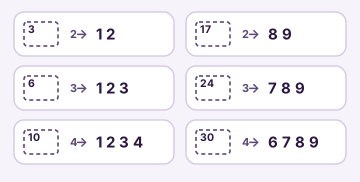
The full list, for every cage size from 2 to 9 cells, is on the combinations calculator page linked under the board. If a cage is already half filled, tick the digits it contains under "Must include" and the list shrinks to what is still possible.
The 45 rule
Every row, column and box contains 1 to 9, so each one adds up to 45. That fixed total lets you work out cells that no cage mentions directly.
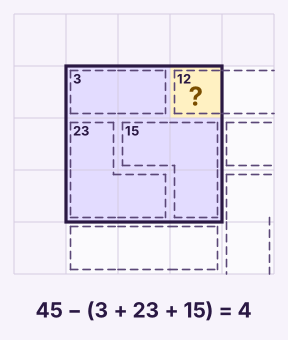
Look at a box where every cell but one is covered by cages that lie completely inside the box. The box totals 45, so the leftover cell must be 45 minus the sum of those cages. This is an innie: a cell that sticks into the unit from a cage that mostly lies elsewhere. The mirror image is an outie: when cages reach out of a unit, the cells outside it must add up to the difference between the cages' total and the unit's 45.
The same idea works on two or three neighbouring rows, columns or boxes (the totals become 90 or 135). Medium puzzles need the rule on one unit at a time; Hard puzzles ask you to combine several.
Techniques for Hard puzzles
- Combination against candidates. A cage worth 14 in three cells could be 1-4-9, 2-3-9 and so on. If the column already rules out 9 for every cell of the cage, delete every combination that needs a 9.
- Pairs. When two cells of a row, column, box or cage can only hold the same two digits, no other cell of that unit can take them.
- Pointing. If a digit must go in one of two cells of a cage and both lie in the same row, the digit is excluded from the rest of that row.
- Several units at once. Combine the 45 rule over a stack of boxes with the cages that stick out of it to pin down a single cell.
Tips for faster solving
- Scan the unique combinations first, then the 45 rule on the edges of the board, then the corners.
- Pencil notes only where you need them. On Easy and Medium, many cells fill straight from the combination helper.
- If you are stuck, use a hint: it fills one cell and names the technique that finds it, so you can learn the move.
- On a phone, use the zoom option in the more menu if the cage sums are hard to read.
FAQ
- Is this Killer Sudoku free?
- Yes. Every puzzle in every level is free, with no account and nothing to install. Your progress stays on your device.
- Does every puzzle have exactly one solution?
- Yes. Each puzzle is built by a program that checks the solution count with an exact solver and then solves the puzzle with human techniques. If either check fails, the puzzle is discarded.
- Do I ever need to guess?
- No. A puzzle is only kept when the techniques of its level can solve it from start to finish.
- What is the difference between Killer Sudoku and normal sudoku?
- Normal sudoku gives you starting digits. Killer Sudoku gives you none and adds cages with sums instead, which makes arithmetic and combinations part of the solving.
- Can the same digit appear twice in a cage?
- No. A cage behaves like a small row: its digits must all be different. The same digit can sit in two different cages.
- Where can I look up which digits can make a given sum?
- Open the combinations calculator from the link under the board. It lists every combination for 2 to 9 cells and lets you filter by digits you need or want to exclude.